Your Brain on Belief: The Neuroscience of Limiting Thoughts (and How to Break Free)
Why the stories you repeat become the reality you live — and how to rewrite them.
The Beliefs You Carry Are Quietly Carrying You
Have you ever wondered why certain patterns in your life keep repeating — the same doubts, the same fears, the same “I know I can do more, but something holds me back”?
Most people assume they’re “stuck” because of circumstances.
But neuroscience tells a different story:
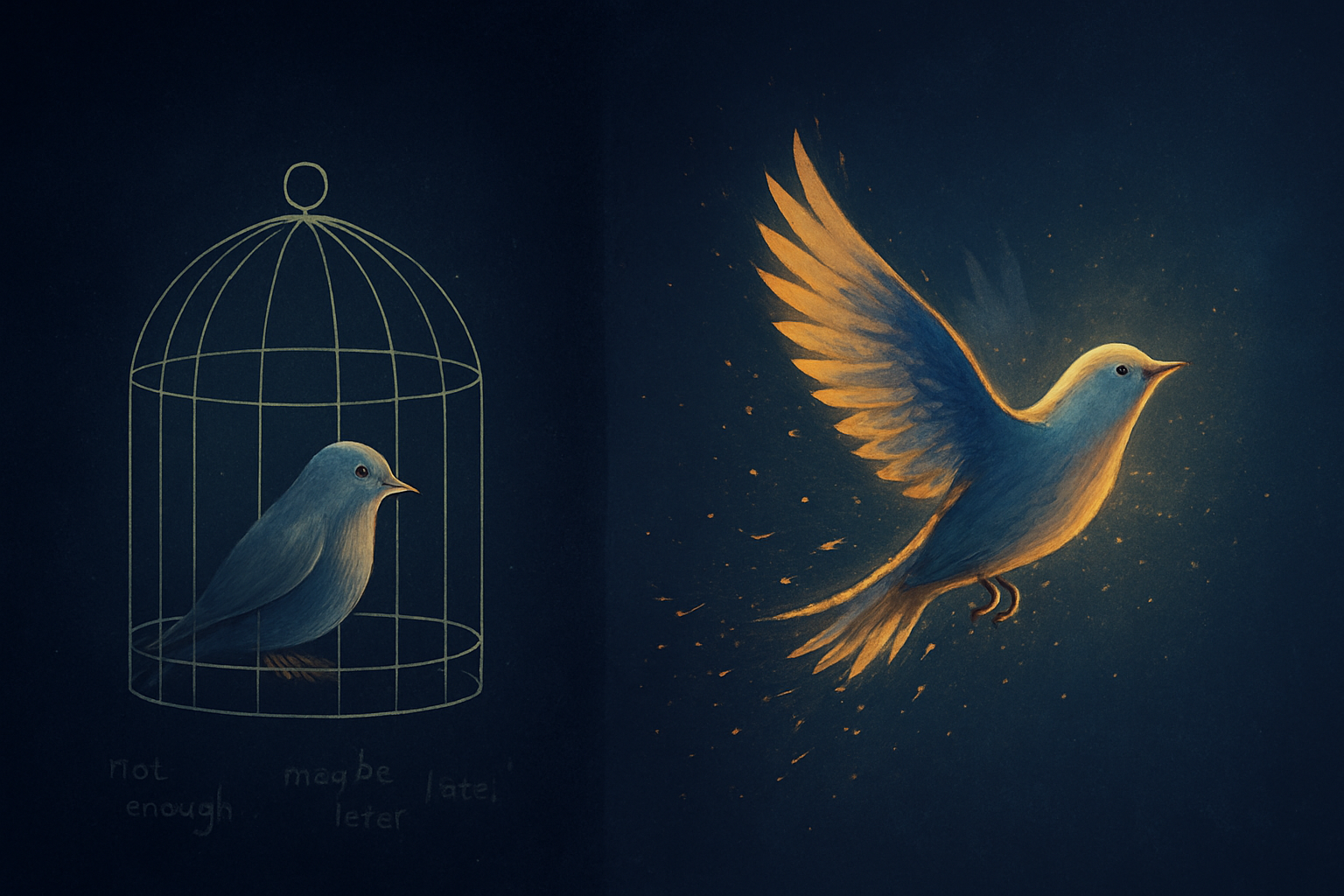
You’re stuck because your brain has been trained to believe a particular story — one you didn’t consciously choose, but one your mind faithfully follows.
Beliefs are not abstract ideas floating around in your head.
They’re physical structures — neural pathways that your brain treats as the truth.
And the most life-altering part?
They can be changed.
The Neuroscience of Belief: How Thoughts Become “Truths” in Your Brain
Your brain is constantly learning what to expect from the world.
It’s always asking:
“What do I believe is true?”
“What usually happens?”
“What should I prepare for?”
The answers come from repetition — not accuracy.
🧠 1. Hebbian Learning: “Neurons that fire together, wire together.”
Psychologist Donald Hebb (1949) discovered that when two neurons activate at the same time, the connection between them strengthens.
This is the foundation of belief formation.
Think something often enough…
Feel something strongly enough…
Repeat a story long enough…
And your brain wires it in as a “fact.”
🧠 2. The Default Mode Network (DMN): Your Internal Storyteller
The DMN (Raichle et al., 2001) activates when your mind wanders — replaying memories, imagining the future, and building internal narratives.
When your DMN runs on autopilot, it usually pulls from old beliefs, not new possibilities.
This is why negative self-talk feels “true” even when it isn’t.
🧠 3. The Amygdala: The Emotional Gatekeeper
Your amygdala learns emotional meaning from experience.
If you’ve ever failed, been judged, abandoned, or embarrassed, the amygdala marks those moments as warnings — and reinforces beliefs like:
- “I’m not good enough.”
- “It’s safer not to try.”
- “People always leave.”
- “Success isn’t for people like me.”
These aren’t personality traits —
they’re emotional memories repeating themselves.
Self-Limiting Beliefs Aren’t Chosen — They’re Learned
Limiting beliefs usually begin as:
- a teacher’s comment
- a childhood comparison
- a painful moment
- an environment where you had to shrink
- an expectation you absorbed without noticing
And slowly, they become mental habits.
Not because they’re true —
but because your brain prefers familiarity over accuracy.
This is why many people say:
“I feel like something inside me is blocking my progress.”
They’re right.
There is something — but it’s not mysterious.
It’s neurological.
The Cycle of Limiting Thoughts (and How the Brain Keeps You Stuck)
Here’s how the loop works:
- A repeated negative thought appears
(“I always mess things up.”) - The brain wires it in as a pattern
(Hebbian learning strengthens the neural pathway.) - Your Reticular Activating System filters in evidence
(“See? You made a mistake. Proof.”) - Your emotional brain reacts
(Amygdala triggers fear, shame, or avoidance.) - Behaviour follows belief
(You hold back, procrastinate, stay small.) - The inaction reinforces the belief
(“I didn’t do it — so maybe I really can’t.”)
This cycle can last for years.
But the same mechanism that built limiting beliefs
can unbuild them.
” Ready for an Instant Calm? Get the 2-Minute Vagus Nerve Hack Free! ”
How to Rewire Limiting Beliefs: A Practical Brain-Based Method
This exercise is simple, but neurologically powerful.
It interrupts old neural pathways and begins forming new ones.
Step 1 — Catch the Thought (Awareness Weakens Old Wiring)
Throughout the day, notice one limiting story that keeps showing up.
Example:
“I always get stuck.”
“I’m not disciplined enough.”
“I don’t deserve better.”
Label it: “This is a thought, not the truth.”
This breaks the automatic loop.
Step 2 — Question It Gently (DMN Disruption)
Ask yourself:
“Where did I learn this?”
“Is this belief based on facts or habit?”
“What else could be true?”
These questions destabilize the old neural pathway.
Step 3 — Reframe the Narrative (Neuroplasticity in Action)
Choose a believable new thought — not unrealistic, just empowering:
“I’m learning to stay consistent.”
“I’m becoming someone who follows through.”
“I’m building confidence every day.”
Small shifts create sustainable rewiring.
Step 4 — Add Emotion (The Amygdala Needs Feeling to Learn New Patterns)
Close your eyes and feel what the new belief would feel like
— relief, possibility, ease, strength, confidence.
Emotion = the signal that tells the brain,
“Keep this. This matters.”
Step 5 — Repeat Daily (Repetition Builds New Neural Pathways)
5–10 intentional repetitions a day are enough to rewire the circuitry over time.
This is science.
This is neuroplasticity.
This is how identity changes.
“To understand the biological mechanism behind immediate state change, check out the Vagus Nerve Hack for instant calm.
“https://createwiththoughts.com/vagus-nerve-hack
Belief Is a Biological Force — and You Can Use It
The biggest misconception people have is:
“Beliefs are psychological.”
They’re not.
Beliefs are neural architecture.
They live in your brain as electrical patterns, emotional circuits, and chemical habits.
Which means:
- You are not stuck.
- Your past is not your destiny.
- Your inner narrative is not permanent.
The brain that built limiting beliefs
is the same brain that can unbuild them
— and create something far truer, stronger, and more aligned with your highest self.
You’re not “rewiring your brain.”
You’re reclaiming it.
I invite you to share in the comments: What limiting story are you ready to let go of today? Your experience could inspire someone else on their journey.
🔁 Share this article with someone who is ready to step into a new chapter.
📩 Subscribe to receive exclusive weekly insights blending neuroscience with practical tools for your personal growth journey.
References
- Hebb, D. O. (1949). The Organization of Behaviour: A Neuropsychological Theory. Wiley.
- Raichle, M. E. et al. (2001). “A default mode of brain function.” PNAS.
- LeDoux, J. (1996). The Emotional Brain. Simon & Schuster.
- Siegel, D. J. (2012). The Developing Mind. Guilford Press.
- Kandel, E. (2006). In Search of Memory. W.W. Norton.