
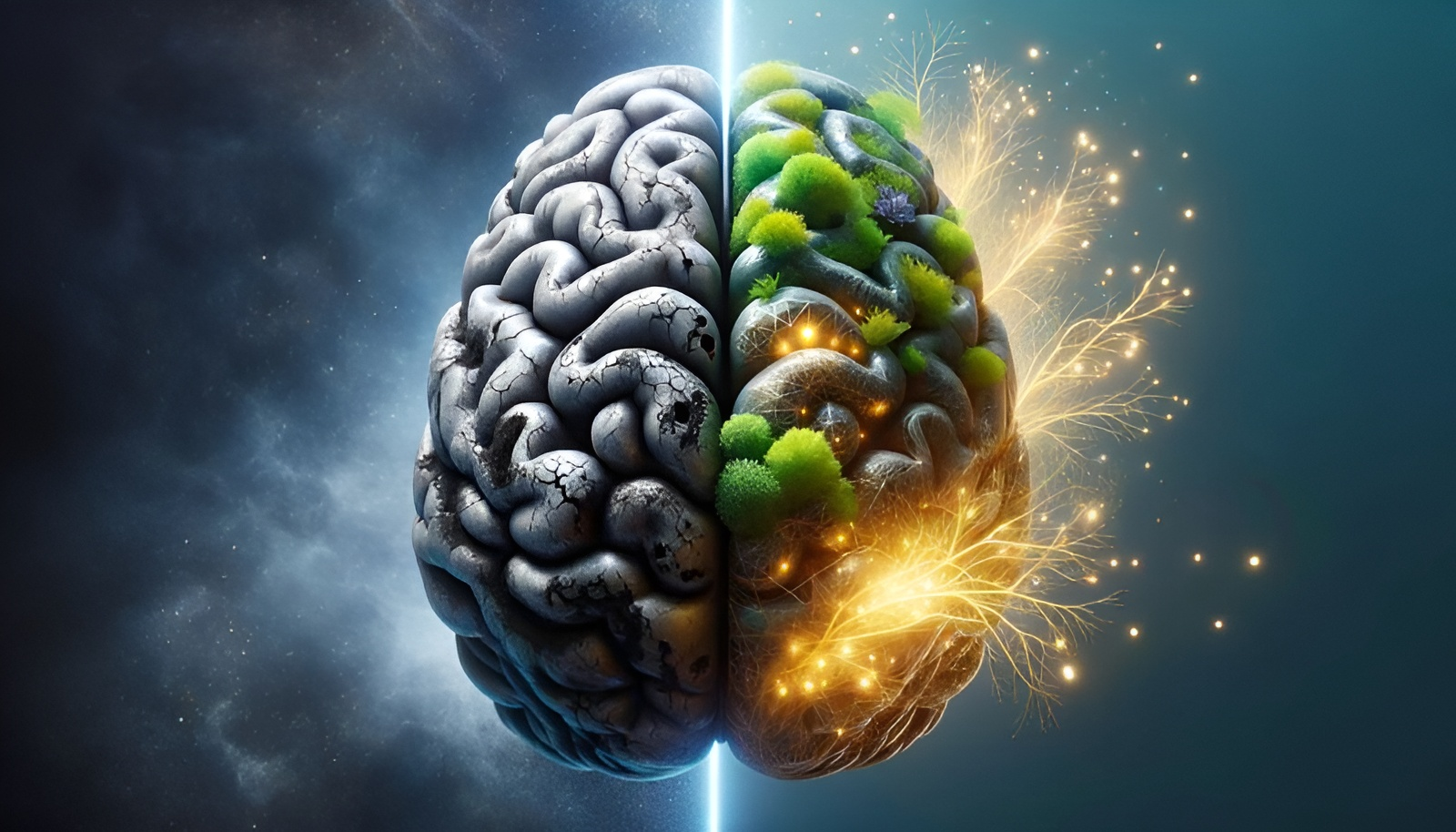
What If Reality Isn’t What It Seems?
Have you ever noticed how two people can experience the same event but walk away with completely different interpretations?
One feels inspired, the other defeated — yet nothing around them changed.
The truth is, we don’t see the world as it is; we see it as we are.
Your brain isn’t just observing reality — it’s building it.
Every belief, every repeated thought, every emotion subtly reshapes how you perceive life.
Modern neuroscience and ancient philosophy are beginning to agree on something profound: your mind is not just a passenger in your reality — it’s the driver.
Let’s explore how the science of thought reveals that your brain doesn’t simply reflect your world — it creates it.
Your Brain Is a Reality Filter
Your brain receives an estimated 11 million bits of sensory information every second — from sounds, sights, and sensations — but you consciously process only about 40 bits.
To cope with this overload, your mind relies on a filtering system called the Reticular Activating System (RAS) — a network in your brainstem that decides what deserves your attention.
Think of your RAS as your brain’s search engine.
Whatever you consistently think about or believe becomes the keywords it prioritizes.
If you constantly tell yourself “I’m unlucky”, your RAS will highlight experiences that reinforce that belief.
But if you start focusing on “I’m capable and opportunities find me”, your brain begins scanning for proof of that instead.
In psychology, this is known as perceptual bias — the brain’s tendency to interpret new information through the lens of what it already believes to be true.
In short: your thoughts train your brain what to notice — and what to ignore.
The Neuroscience Behind Thought and Perception
Studies in cognitive neuroscience confirm that your prefrontal cortex, the region responsible for focus and decision-making, collaborates with emotional centres like the amygdala and hippocampus to filter information based on meaning and emotional value.
When you dwell on a thought — positive or negative — you’re literally strengthening the neural connections related to it.
This process, called Hebbian learning (coined by psychologist Donald Hebb in 1949), is summarized as:
“Neurons that fire together, wire together.”
Over time, repeated thoughts sculpt your brain through neuroplasticity — the brain’s ability to reorganize itself by forming new neural pathways.
That’s why recurring mental patterns eventually become habits, personalities, or emotional defaults.
So, when you think “I’m not good enough” often enough, your brain doesn’t question it — it accepts it as fact.
But the same principle applies to empowering thoughts, too. You can literally train your brain to believe in your own potential.
” Ready for an Instant Calm? Get the 2-Minute Vagus Nerve Hack Free! ”
The Mind–Brain Connection: Science Meets Spirit
Across ancient teachings, from Buddhism to Hermetic philosophy, there’s a shared insight:
“As within, so without.”
Science is now catching up with that timeless truth.
Where spiritual teachings describe thought as energy shaping experience, neuroscience describes it as electrochemical activity shaping perception.
They’re two languages describing the same phenomenon: your inner world becomes your outer experience.
When you focus on gratitude, compassion, or creative intention, your brain floods your body with neurotransmitters like dopamine and serotonin, enhancing mood and openness.
When you focus on fear or resentment, your brain triggers cortisol and adrenaline, narrowing perception and increasing stress.
Your inner chemistry literally paints your experience of life.
How to Rewire Your Brain for a New Reality
You can’t control every thought, but you can direct your focus — and that changes everything.
Try this simple practice to begin retraining your RAS and activating neuroplasticity in your favor:
- Pause and Observe.
A few times a day, stop and ask, “What story am I telling myself right now?” Notice whether your thoughts are expansive or limiting. - Interrupt the Loop.
When you catch a negative pattern (“I’ll never change,” “It’s too late”), pause and label it as a thought, not a truth. - Reframe and Refocus.
Replace it with a conscious thought that aligns with growth: “I’m learning,” “I’m evolving,” or “I’m capable of more.” - Anchor It Emotionally.
Feel the thought in your body. Emotion tells the brain, “These matters.” It’s the key signal that strengthens new neural pathways.
Consistent repetition of this practice shifts your brain’s filters — and as your brain changes, so does what you see, attract, and experience.
“If you’re ready to master the first step—achieving stillness—learn the quickest way to activate your Vagus Nerve before meditation.
“https://createwiththoughts.com/vagus-nerve-hack
See Differently, Live Differently
Your thoughts are not background noise — they’re the architecture of your perception.
Your brain is listening, shaping, and aligning with whatever narrative you feed it.
When you understand that, you stop living by default and start creating by design.
You realize that you are not at the mercy of circumstance — you are the author of the lens through which you see the world.
“The moment you change the way you see the world; the world changes the way it appears to you.”
— Dr. Joe Dispenza, Breaking the Habit of Being Yourself
If this post resonated with you:
Comment below — What thought pattern are you ready to change?
Share this article with someone who could use a reminder of their mind’s power.
Subscribe to my newsletter for weekly insights on neuroscience, consciousness, and the art of mastering your mind — where science meets spirit.
References
- Hebb, D. O. (1949). The Organization of Behaviour: A Neuropsychological Theory. Wiley.
- Baars, B. J., & Gage, N. M. (2010). Cognition, Brain, and Consciousness: Introduction to Cognitive Neuroscience. Academic Press.
- Dispenza, J. (2012). Breaking the Habit of Being Yourself: How to Lose Your Mind and Create a New One. Hay House.
- LeDoux, J. (1996). The Emotional Brain: The Mysterious Underpinnings of Emotional Life. Simon & Schuster.